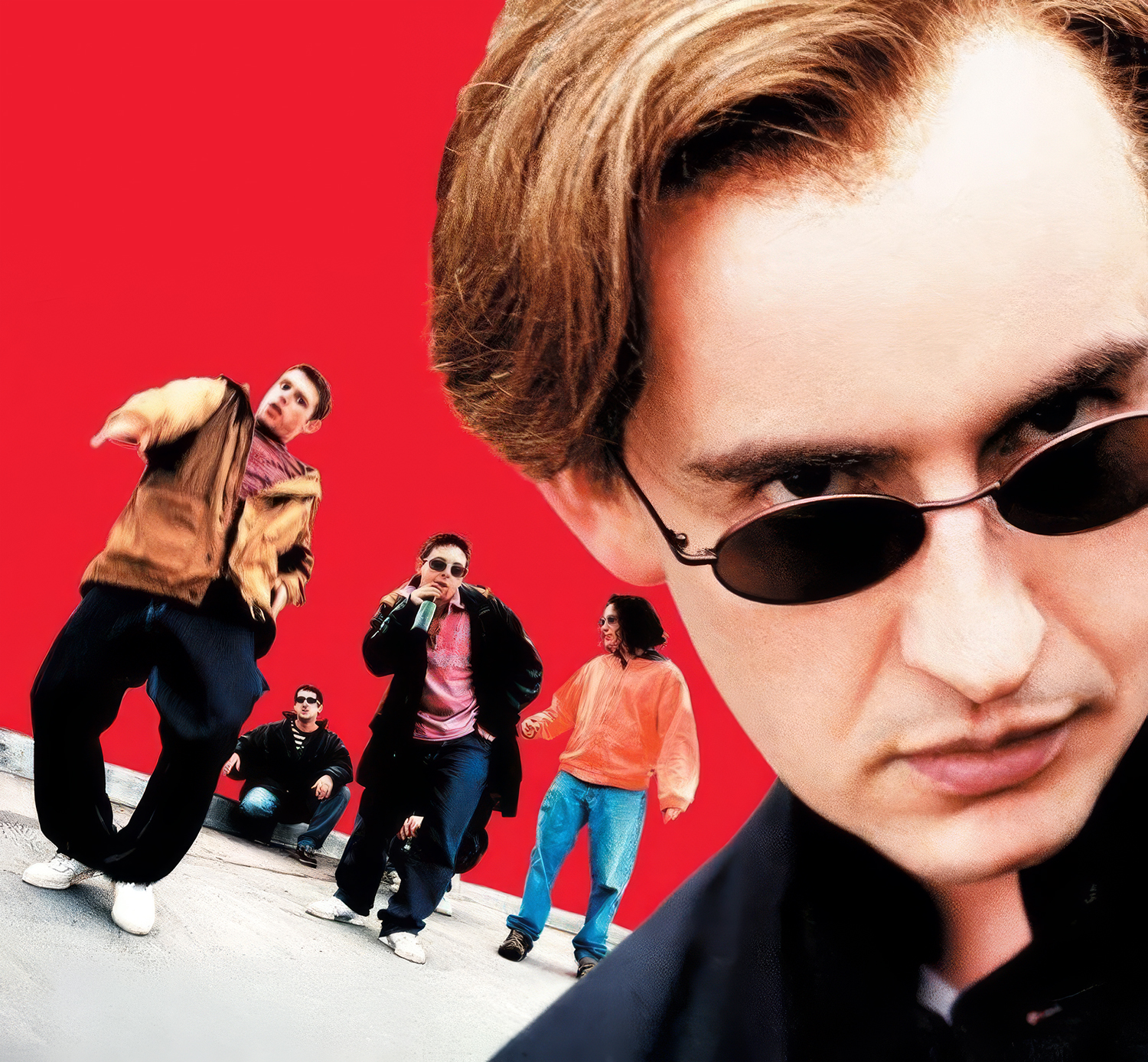
Tony Wilson once said that if it came down to a choice between the legend and the facts, you should print the legend.
24 Hour Party People takes him at his word.
Everything in this film happened.
Well, more or less.
Maybe not quite the way it’s presented on screen. Maybe some quotations have been lifted from one occasion and deposited somewhere more dramatically convenient. Events are compressed. Timelines are rearranged. Some stories are legends that the people involved still can’t agree actually happened.
But this is a film recounting a tale assembled from the memories, memoirs and occasionally unreliable recollections of the people who lived it.
And memory is a notoriously unreliable narrator.
But let’s rewind a bit.
24 Hour Party People is the story of one man and his extraordinary impact on music and culture.
No. It’s about a collection of remarkable creative artists emerging from the streets of a grim northern city.
No. It’s about a record label that fundamentally changed the relationship between music, art and commerce, and still casts an enormous shadow today.
No. It’s about the birth of British club culture.
No. It’s about Manchester.
No. It’s about life.
For the uninitiated, 24 Hour Party People tells the story of Factory Records through the eyes of its founder and all-round cultural icon Anthony H. Wilson.
Television presenter. Businessman. Raconteur. Occasional insufferable intellectual. And a man possessed of an almost religious belief in the transformative power of art and music.
Factory Records and its associated artists have inspired an extraordinary volume of books, films, documentaries and column inches. The mythology surrounding the label sometimes threatens to overwhelm the music itself.
Which is quite an achievement when that music includes Joy Division, New Order and Happy Mondays.
Factory’s defining philosophy was that music was art and musicians were artists. Commercial considerations were secondary, if they were considered at all. The label’s records, sleeves, posters and even its stationery became part of a grand artistic endeavour.
Everything had a catalogue number. Everything was important.
Even the things that weren’t.
The established music industry didn’t always understand. The accountants certainly didn’t. But Factory released records.
Occasionally bloody brilliant ones.
And in doing so, changed how an entire generation thought about music.
Most importantly, Tony Wilson believed in his hometown.
Manchester.
He believed that with the right support, a little imagination and an almost unreasonable amount of self-belief, the city could produce the greatest art in the world.
And he believed Manchester deserved its own cathedral to music, hedonism and excess.
“The Haçienda must be built.“
The phrase came from Situationist precursor Ivan Chtcheglov, writing in 1953 about the possibilities of transforming everyday life through the construction of new environments.
Thirty years later, Factory took him rather literally.
A nightclub in a converted Manchester warehouse, The Haçienda became an experiment in architecture, culture and collective experience. A place where the audience was as important as the performers, where the distinction between artist and participant began to dissolve.
The Situationists would probably have approved.
Until somebody showed them the accounts.
The film charts the rise and fall of Factory, beginning with the legendary Sex Pistols performance at Manchester’s Lesser Free Trade Hall in June 1976. One of those gigs that apparently everybody in Manchester attended, despite there being only a few dozen people in the room.
From that particular cultural explosion emerge Joy Division, Factory’s first defining artists, followed by New Order, the establishment of the Haçienda and the label’s increasingly precarious financial adventures.
Then comes the glorious moment when everything seems to go right.
Guitars and dance music collide. Happy Mondays threaten to rule the world. The Haçienda becomes the centre of a new cultural universe. Acid house and rave transform British youth culture.
Manchester is no longer looking towards London for permission. For a brief moment, London is looking north.
And then everything goes wrong again.
The financial consequences of years of artistic freedom and commercial indifference finally catch up with Factory. The label collapses in 1992, even as its cultural influence is reaching extraordinary heights. The Haçienda survives a few more years before closing in 1997.
Just when they won, they lost.
Or perhaps winning was never really the point.
Originally released in 2002, Michael Winterbottom’s film now celebrates its 24th anniversary with a new restoration and a return to British cinemas.
Twenty-four years.
An anniversary calculated to remind you that time moves rather faster than anybody reasonably expects.
The film itself is a who’s who of British acting and comedy talent from the period. John Simm, Ralf Little, John Thomson, Paddy Considine, Rob Brydon, Christopher Eccleston, Simon Pegg and Peter Kay all appear, inhabiting the peculiar universe of Factory Records and the people who made it happen.
At its centre is Steve Coogan’s extraordinary portrayal of Wilson. Coogan is a fellow son of Manchester who captures both the magnificent arrogance and the genuine idealism of the man himself. His take on Wilson is frequently pompous, occasionally ridiculous and almost always convinced he’s the cleverest person in the room.
Which, irritatingly, he sometimes is.
But this isn’t simply a comedy.
The suicide of Joy Division frontman Ian Curtis casts an enormous shadow across the first half of the film. Elsewhere, addiction, financial ruin, damaged relationships and the increasingly destructive excesses of the music industry threaten to consume the people responsible for creating something extraordinary.
There is real tragedy here.
Yet the assembled cast bring a remarkable lightness of touch to proceedings. Some moments are laugh-out-loud funny. Others are uncomfortable. Some are genuinely heartbreaking.
And some are simply absurd.
Because life is frequently absurd.
Especially when Shaun Ryder is involved.
The film also knows exactly what it is.
Postmodernism, knowing asides, Easter eggs and outright fourth-wall breaking run throughout. Characters interrupt the narrative. Historical accuracy is questioned by the people supposedly recounting it. Real participants appear in cameo roles, sometimes playing themselves and sometimes decidedly not.
Wilson himself makes the briefest of appearances as a television producer at Granada, where he spent much of his professional life.
Coogan narrates proceedings directly to camera, occasionally pausing the action to explain what is happening, why it matters or whether the events depicted actually occurred.
At one point, the film effectively acknowledges that a particularly good story is worth including even if its historical credentials are questionable.
And why not?
The film is about the creation of mythology. It would be rather disappointing if it didn’t create a little of its own.
In its final moments, Wilson even meets God.
Who, naturally, looks remarkably like Tony Wilson.
There is something gloriously appropriate about a man who spent his life constructing his own cultural universe eventually finding himself in conversation with its creator.
Even if that creator turns out to be himself.
But behind the jokes and the myth-making sits a genuine sadness.
So many of the people responsible for creating this extraordinary moment in British culture departed far too early.
Ian Curtis died before Joy Division could fully realise their potential. Mercurial producer Martin Hannett followed in 1991. Manager Rob Gretton died in 1999.
Wilson himself died in 2007, aged just 57.
Manchester turned out to mourn him. The man who had spent his life insisting that his city could produce culture as important as anywhere else in the world had become one of its defining cultural figures.
Not bad for a television presenter with a record label that never seemed to make any money.
“This is Manchester. We do things differently here.”
Wilson said that.
Or perhaps he didn’t.
As with so much surrounding Factory, the precise provenance of the words is less important than the sentiment.
Wilson certainly did things differently.
And the world is considerably more interesting because he did.
At its heart, 24 Hour Party People is a warm, funny and occasionally heartbreaking love letter to a time and place that has long since passed into folklore.
But it’s also a reminder of something that seems increasingly unfashionable.
That culture doesn’t have to be created by committee. That artistic ambition doesn’t need to be justified by a business plan. That a city doesn’t have to wait for permission to become important.
Sometimes all it takes is a few people with ridiculous ideas and the conviction to make them happen.
Sometimes they succeed.
Sometimes they fail spectacularly.
And sometimes, if they’re very lucky, somebody makes a film about them twenty years later.
Then brings it back to the cinema twenty-four years after that.
The facts are all there.
More or less.
But Tony Wilson understood something fundamental about art, music and the human condition.
The legend is what survives.
Print the legend.
24 Hour Party People has been meticulously restored for it’s anniversary and there are a series of cinema screenings and special events across the UK to commemorate that. The film itself will be released on a new 4k edition in November. The original film can generally be found on streaming services.

 Tap Share, then Add to Home Screen.