
James Blake posted about the collapse of belief across music. James Blake pointed to bad record deals, fake fan accounts, inflated numbers, AI-made songs and reviews that, in his view, people can no longer trust because journalists are paid by labels.
Most of that belongs inside a real and ugly release-and-hype system. The swipe at music writers still lands on the wrong target.
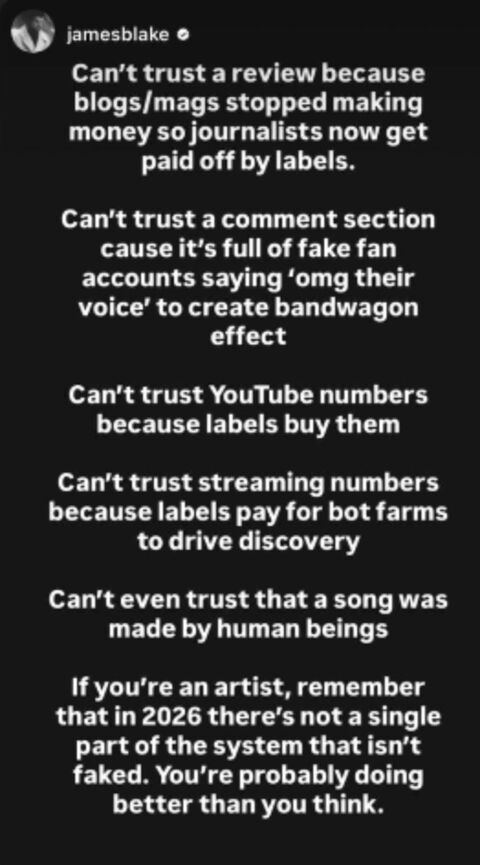
I have seen the same accusation thrown at writers in games, film, TV and music. Every time, it makes me scratch my head in confusion. I have worked with hundreds of journalists across those industries. The people I know are not living off label money.
They work for a pittance because they love recommending bands, writing about culture and sharing work they think deserves attention. Not one journalist I have worked with has ever taken payment from a label, publisher, studio or developer to write good things.
Some publications do take payment for coverage, and I tell anyone who will listen to never pay them. Better and more reputable places are crying out to write about good work.
Google is the gatekeeper that broke the room
The real target should be Google. The company that still tells its workers, in its current code, “don’t be evil” has become evil in every publishing sense.
Google is the gate, the lock, the landlord, the rent collector and the bailiff. It decides which sites people see, which writers matter and which pieces of original work disappear from view. Google is no longer a signpost to the open web. It now acts like the owner of the road, the map and the destination.
At TuneFountain, the whole point is to focus on upcoming artists and bands who bigger outlets often ignore. We write about people without major label budgets, legacy media access or teams large enough to force them into the conversation, which is why TuneFountain exists in the first place.
That work already takes patience, care and stubborn belief. It becomes close to impossible when everything we write feeds Google’s AI monster. Our words can be paraphrased above links to our own content. Google keeps the answer, the reader and the advertising space, while the original article loses traffic, context and credit.
Opting out does not fix the damage
A recent BBC report on Google AI search results underlines how insulting the proposed fix is. Instead of giving original journalism the exposure it has earned, Google offers publishers a way to opt out of AI Overviews.
That does not repair a broken system. It tells publishers to choose between letting Google mine their work for answers or stepping away from one of the main places readers now look.
Google still keeps the page, the audience, the ads and the power. Publishers get a door marked “leave” inside a room Google built, owns and controls.
This is not abstract for music. We have already seen how fast machine-made culture can move into the space where real scenes should live, from the fake-band fog around The Velvet Sundown to the wider questions raised by the BBC Introducing AI controversy.
Human writers can spend years building confidence with readers. They can report properly, write with context and serve communities. Then their work can sink beneath AI summaries, scraped rewrites and empty pages designed to please the algorithm.
Google calls this progress. For independent publishers, it feels like erasure.
The accusation should not be that honest writers hide paid praise inside reviews. The accusation should be that Google hides human content, misattributes original journalism and platforms AI-generated pages over work made by people with taste, memory and accountability.
Paid coverage is not the same as criticism
Paid advertising, paid editorial and genuine review coverage are different things. Artists deserve to know where the line sits. A paid advert should carry a label. Paid editorial should make the arrangement clear. A review should offer independent criticism, with no fee changing hands for the opinion.
Anything pretending to be a review while selling praise deserves to be called out. That is not the same as smearing a whole profession.
Most music writers are trying to keep a small corner of culture alive. They do that while traffic falls, search rules shift without warning and the sites that once helped artists reach audiences can barely breathe.
Then comes the advertising trap. Google helps shape the ad economy and serves many of the formats that make the web worse to read. Ad income keeps falling, so publishers run more placements to survive. Then Google punishes publishers when they use too many of the tools they need to stay alive.
That is a grotesque business model. It is like selling someone a leaking boat, charging them for buckets, then blaming them for getting water on the deck.
Independent music media is doing public-service work
This is where the wider conversation around James Blake should go. Music journalism is not collapsing because writers have secretly sold their ethics.
It is collapsing because the biggest traffic machine on earth has turned independent publishing into a begging bowl. The Drowned in Sound response to James Blake gets to the heart of why this matters: the comments smear a profession that helped build credibility around artists in the first place.
Small publications, blogs, newsletters, podcasts and specialist sites often run around day jobs, debt, burnout and falling traffic. Those people are not the enemy.
Artists can spot reputable coverage because it looks like journalism, not a checkout page. It has named writers, editorial standards, real archives, transparent advertising and a tone that sounds like someone has listened.
The bad actors exist, but they are not the rule. Writers and editors usually know them, avoid them and call them out.
Social platforms make this worse because suspicion travels faster than context. A sweeping claim about paid reviews will move further than a careful explanation of how small music sites work.
Posts that frame reviews as corrupt feed the wrong fire. They make artists less likely to believe the humans still listening properly.
The only winners are the platforms and content mills that thrive when nobody has faith in anything. Independent music media documents scenes, keeps smaller artists visible and gives context to records that would otherwise vanish.
The music industry has a credibility problem, but honest criticism is not the enemy. Google is the gatekeeper deciding what succeeds, what disappears and what gets mistaken for truth, and that should anger every artist, writer and reader who still cares about culture with a pulse.
Photo: Ferran, licensed under CC BY 2.0.

 Tap Share, then Add to Home Screen.