
Emily Volt makes it clear in this interview: her rock music comes with bite, theatre and a bruised sense of honesty. Across TV Stopped Working, ‘Misleading Fortune’ and the songs around them, her sound leans on guitars with attitude, vocals that cut through the noise, and writing that turns inner pressure into something loud enough to face.
TV Stopped Working, her four-track EP, arrived with confidence, character and a strong sense of story. ‘Misleading Fortune’ then pushed her writing into a more direct confrontation with status, money and shallow social judgement.
More on Emily Volt
At the centre of Emily Volt is a songwriting habit that feels almost immediate. She takes the first spark, follows the impulse, and lets the performance give it shape. The songs can be tender, angry, self-aware and theatrical, but they never feel detached from the person writing them.
Asked whether the sharpness and attitude in her music feel like a natural reflection of who she is, or something she has grown into as an artist, Emily does not present it as a persona. “It’s definitely a reflection of who I am,” she says. “Writing the songs helps me put what I think down and bring my feelings across. I am a feeling-led person and I love that.”
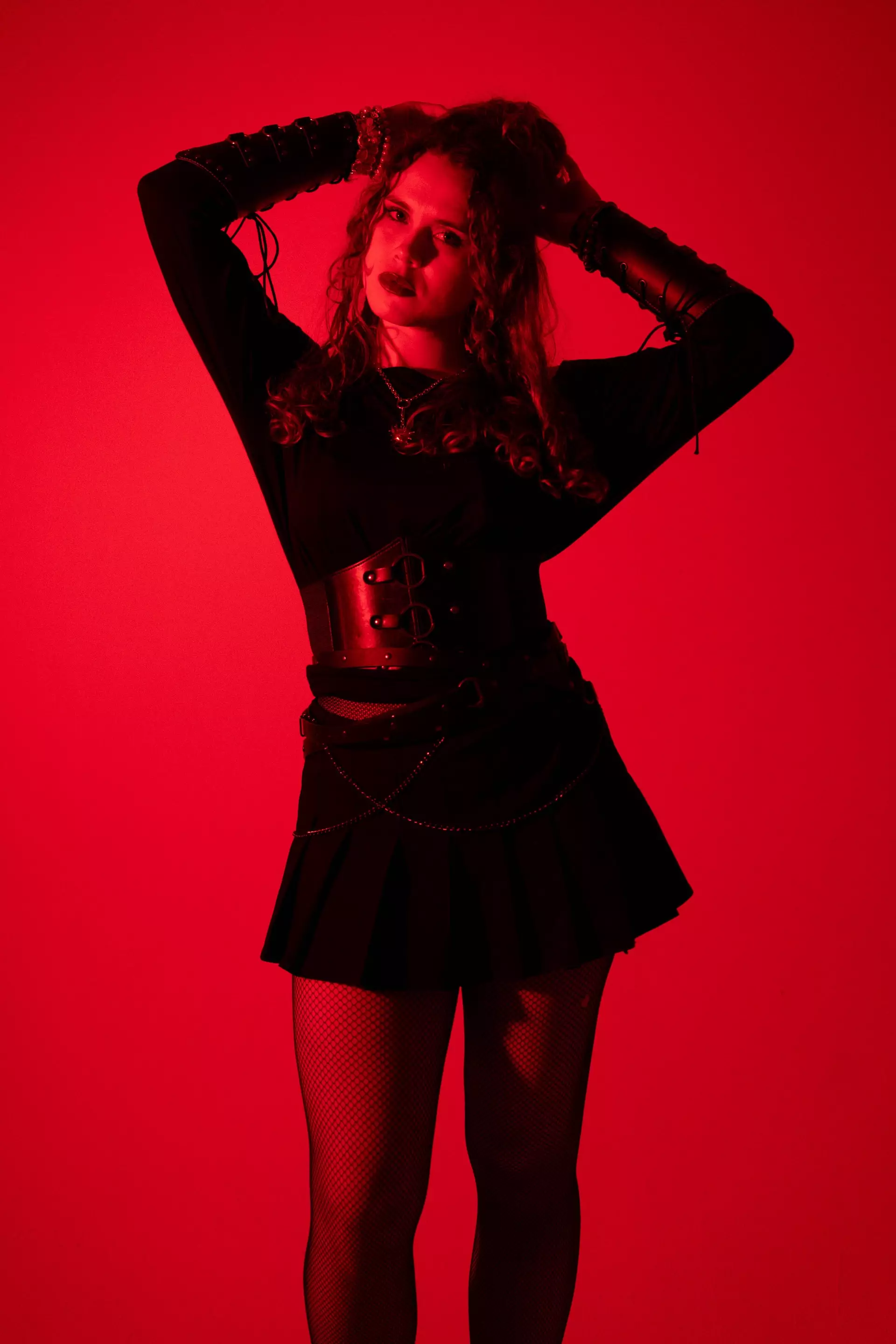
For Emily, music starts with the fact that she feels a lot. “To me, making music means feeling things,” she says. “Music has always been something that reflects who I am.”
Inside TV Stopped Working
That closeness sits at the heart of TV Stopped Working. The EP has a strong sense of personality, but Emily now hears it as something tied to a period of change, closure and feelings that still follow her in some form.
“I wrote the project during a transformative time where I had to close a lot of chapters in my life,” Emily says. “This EP will always have a place in my heart and I will always relate to it in some way.”
She says TV Stopped Working touches on “desperation and anger, loss and sadness and even depression”. While she has found closure around many of the experiences behind the EP, Emily says “the feelings I had will always be a part of me”.
The EP feels less like a sealed chapter and more like a snapshot of someone still moving through it. Emily can look back on the project with distance, but she does not treat the weight behind it as something neatly left behind.
‘Misleading Fortune’ and shallow social judgement
On ‘Misleading Fortune’, the focus turns outward. The song feels pointed because it came from frustration with superficial people. It also takes aim at the way money, appearance and social status can shape how some people treat others.
“Oh yeah, it’s an opinionated song,” Emily says. “It’s my take on dealing with people who are incredibly superficial. After interactions I had with them, I started feeling sucked into their views and like I had to change parts about myself to fit their shallow standards.”
She was fed up with money and social status entering the conversation at all, especially when they were used to decide how a person should be treated or spoken about. “I still cannot believe there are people that will treat someone differently based on their income, their possessions or even their looks,” Emily says.
Emily Volt on fragility, performance and heavier music
Emily does not talk about writing with bite and writing with vulnerability as two separate lanes. When asked whether one side satisfies her more creatively, she says she rarely starts with that kind of decision. The feeling arrives first, then the sound begins to take shape around it.
“I never thought about what kind of songs I like to write more,” Emily says. “I guess I don’t think about how I want the song to sound. Usually something happens that triggers an emotion and that emotion then triggers a certain sound.”
That instinct explains why her catalogue can move from sadness to confrontation without feeling split. Emily remembers “sadness, fear and emptiness” while writing some of her more melancholic songs, and “frustration and anger” while writing songs such as ‘Misleading Fortune’ and ‘Deceiving Gaze’.
The same logic applies to Emily on record and off record. There is performance in the clothes, the visuals and the stage space, but she does not describe that side as a mask.
Instead, it becomes a heightened frame around songs that come from personal topics, lived experience and things she has watched other people go through.
“All my songs are about personal topics and about things I have experienced or have seen people experience,” Emily says. “I try to capture that in my music. Of course, when playing shows or working on visuals such as pictures and videos, there is always a performance.”
That performance still comes from the same place. “I love putting on a bold outfit, I love delivering an energetic and artistic performance,” she says, “but in the end, everything I do is a reflection of my art and of how I feel about my art and the topics I discuss in it.”
For Emily, the release of a song is not the end of the process. It is the moment a private spark starts to meet other people, and she loves hearing how listeners respond once a song is out.
“It’s like, hell yes, I felt this way and I am telling you about it and you can relate,” Emily says. “That’s amazing.”
That listener connection also explains why quick comparisons can feel too narrow. Emily understands that influence is part of making music, but she is wary of the assumption that being inspired by someone means trying to copy them.
“Sometimes people compare my music to other big artists, and while being compared to amazing artists is always great, sometimes people think I am trying to copy their sound, especially on social media,” Emily says. “There are so many amazing artists that influence the kind of music I write, but in the end, my music is still me.”
If one song currently gets closest to who she is, Emily points to ‘Fragile’. She gives the same answer when asked about her favourite song she has written, which makes the track feel like an anchor for the wider Emily Volt story.
“For now, it is ‘Fragile’,” Emily says. “For me, this song is representative of acknowledging that horrible things happen in life and that they will change you. It’s about loving yourself even when living with trauma is hard and allowing yourself to be fragile.”
That answer adds another layer to her heavier instincts. The bite in Emily’s music is not there to shut softness out. It can sit beside fragility, self-protection and the work of naming what has happened.
Building beyond TV Stopped Working
One part of her process she wishes people asked about more is lyric writing. Emily says she struggled with lyrics when she first started writing songs, especially because English is not her first language. Over time, that part of the work has become something she enjoys.
“I have started enjoying the process of writing them,” Emily says, “and I’d love to talk about the process of lyric writing more.”
When she feels creatively stuck, the way back in is usually a sharp impulse rather than a strict method. “It’s usually a sharp emotion that triggers a writing process for me when I feel stuck,” Emily says. “Sometimes talking about something doesn’t help, sometimes even words can’t help, only a melody can.”
She describes creative outbursts that begin with something happening in her life. After that, there is often a period of thinking before a lyric idea or melody appears.
“I might not write a song immediately,” Emily says, “but I do start thinking a lot. Then maybe the next day I have a lyric idea and then a little melody idea and I start putting them together.”
Even then, the song can keep shifting. “Sometimes it’s not what I actually end up using and I revisit the song again after a couple of days,” Emily says. “It usually sounds different to the first idea I had but I can definitely tell the influence of the initial version I wrote in the song. It’s like the song evolves with the different stages of emotions I go through.”
That way of writing explains why Emily is already thinking beyond one-off releases. She still has a couple of singles planned, but she wants another EP next year after enjoying the process behind TV Stopped Working.
“I definitely am,” Emily says when asked if she feels she is building towards something larger. “I still have a couple of singles planned but I definitely want to release another EP next year. I had so much fun writing, recording and releasing TV Stopped Working that I want to do it all over again.”
The next phase may grow from the same artistic space rather than abandon it. Emily says she wants to expand the sound and world of TV Stopped Working, and she is drawn to building themes that a piece of art can live inside.
“I love building worlds and themes that a piece of art can live in,” Emily says. “All I can say is that it is going to get heavy fast.”
A full album is also part of the longer dream, even if it is not currently planned for financial reasons. Emily sees the format as a chance to bring more perspectives and depth to one theme, topic or feeling than a song or EP can hold.
“I would absolutely love to make an album,” Emily says. “It is currently not planned purely out of financial reasons, but one day, absolutely. I feel like an album can provide even more perspectives and depth on a theme, topic and feeling than a song or an EP.”
She is drawn to concept albums and records with a coherent musical and lyrical theme throughout. “There is something about hearing the theme of the opening track in one of the other songs or having different lyrical takes on the same theme,” Emily says. “I would love to do something like that.”
You can already hear the shape of what Emily is building: songs led by instinct, a rock sound with bite, visuals that sharpen the mood, and a writer who knows softness can hit as hard as volume.
Read more about TV Stopped Working and follow Emily Volt on Instagram.

 Tap Share, then Add to Home Screen.